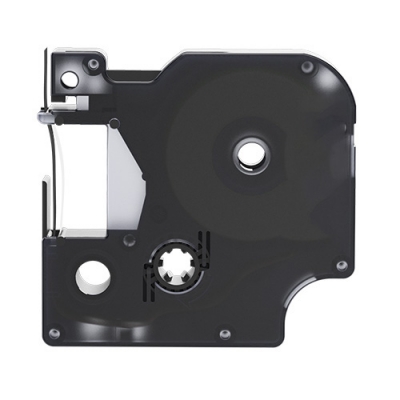
Musta / keltainen
Tämä vahanauha on yleisimmin käytetty ja edullisin vaihtoehto paperitarrojen lämpösiirtotulostukseen. Tulostatko pääasiassa sisätiloissa tarroja, jotka eivät altistu kitkalle, kosteudelle tai kemikaaleille, kuten osoite- tai lähetystarroja, varastotarroja tai hintalappuja? Sitten tämä on juuri se, mitä tarvitset. Lämpösiirtonauhan mitat ovat 110 mm × 300 m.
Ero verrattuna hartsinauhaan tai vaha/hartsinauhoihin näkyy tulosteen kestävyydessä. Vaha tarttuu hyvin tavalliseen ja pinnoitettuun paperiin, mutta tuloste on herkempi naarmuuntumiselle, kosteudelle ja lämmölle kuin hartsinauhalla tehty tuloste. Ulkona oleville, kemikaalien kanssa kosketuksiin joutuville tai usein pyyhittäville tarroille hartsi- tai vaha/hartsinauha sopii paremmin. Useimpiin sisäkäyttökohteisiin vaha kuitenkin riittää hyvin ja on huomattavasti edullisempi.
Tätä nauhaa käytetään lämpösiirtotulostimessa, ei suoralämpötulostimessa. Tulostuspää sulattaa nauhan vahapinnoitteen tarraan ja tuottaa terävän, kestävän tulosteen, joka ei haalistu samalla tavoin kuin suoralämpötulosteet usein haalistuvat.
Sopii useimpiin tätä nauhakokoa tukeviin tarratulostimiin, kuten valmistajien Zebra, Honeywell, TSC, Godex ja Citizen tulostimiin.
Wax, wax/resin and resin describe the ink layer on a thermal transfer ribbon. Wax melts at the lowest temperature and is the most affordable, but the print is the least resistant to scratching, moisture and chemicals. Resin needs the most heat but gives the most durable, chemical-resistant print. Wax/resin sits in between on both price and durability.
As a rule of thumb: paper labels for general use → wax. Coated paper or plastic labels for everyday handling → wax/resin. Plastic labels (PP, PE, PET) that need to survive heavy wear, chemicals or long-term outdoor use → resin. This is a guideline, not an absolute rule: the exact label surface and coating also matter.
As an example: with labels of 100 x 150 mm and a 3 mm gap, each label uses about 153 mm of ribbon. A 300 metre roll (300,000 mm) then gives roughly 300,000 ÷ 153 ≈ 1,960 labels.
This is a theoretical figure; loading, calibrating and swapping rolls always uses up a small amount of ribbon in practice. To estimate for your own labels: ribbon length in mm ÷ (label length + gap in mm).
For narrower labels, yes: a wider ribbon than needed still works technically, but part of it is never printed on, which wastes material. For labels wider than about 105-107mm (leaving a couple of millimetres of margin), this 110mm ribbon may no longer fully cover the label web, which risks printhead wear and edge print-quality issues.
The safest approach is to pick a ribbon width just a few millimetres wider than your actual label web, including the backing paper.
Yes. This ribbon is a compatible product, not an original Zebra cartridge, and it physically fits any label printer that accepts this width, core diameter and winding direction, regardless of brand. In practice that includes brands such as Zebra, Honeywell, TSC, Godex and Citizen.
Before ordering, it's worth checking your printer's manual for the maximum ribbon width and length it supports, and whether it needs ink-in or ink-out winding, since that's more about the printer model than the brand.